Hello everyone,
I’m encountering several issues while running a 3D subduction simulation and would like to seek your advice.
First, in my model, the oceanic crust on the subducting slab isn’t actually subducting downward. Instead, it appears to melt away. While the subducting slab entering from the boundary maintains its original shape, the lower oceanic crust seems to merge or fuse with the base of the overriding plate instead of subducting downward.
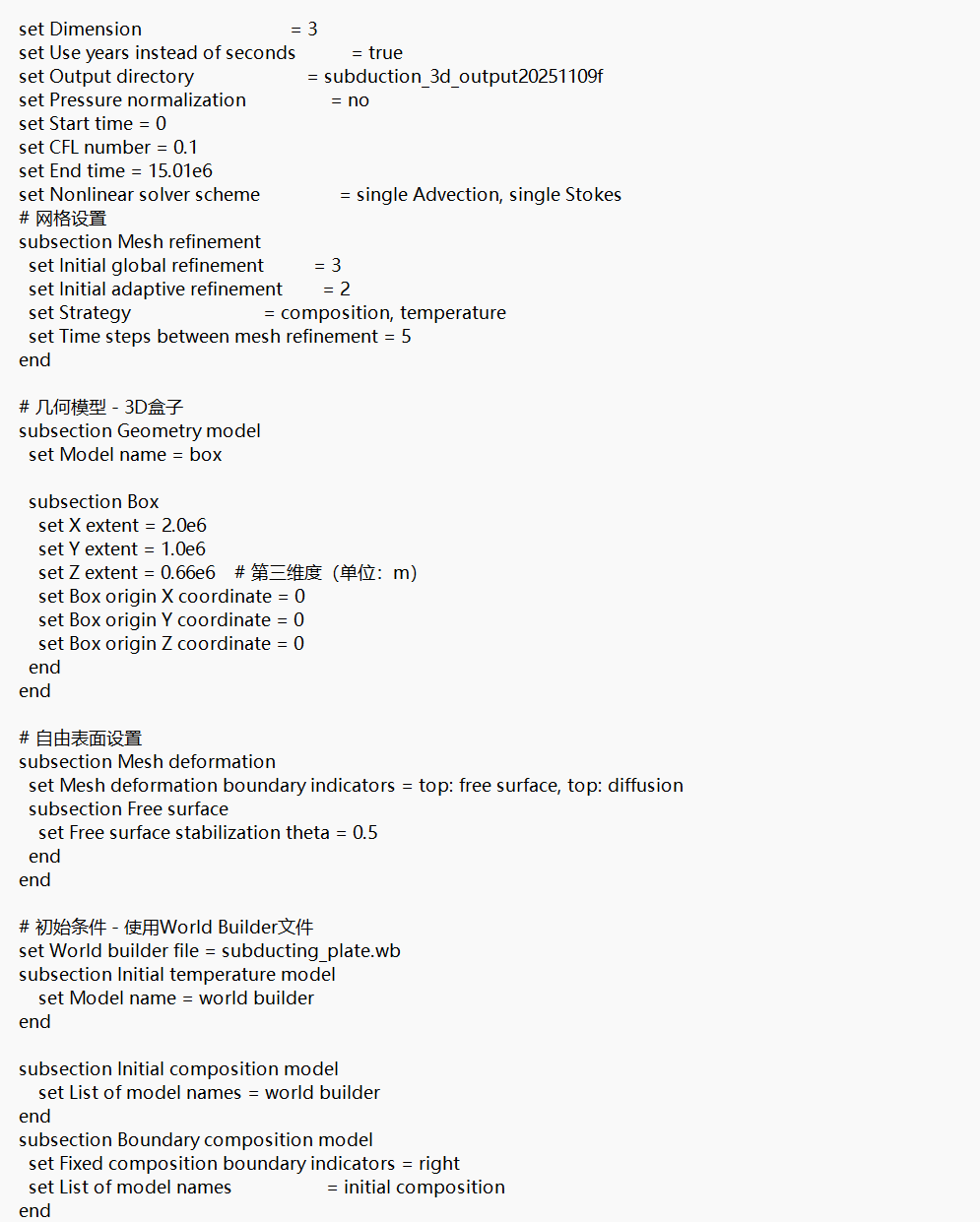
After observing this behavior, I suspected that my mesh might be too coarse to properly resolve the 20km-thick oceanic crust. Therefore, I increased the parameters:
-
set Initial global refinement = 3→5 -
set Initial adaptive refinement = 2→4
However, this adjustment caused the time step (dt) to decrease to around 2000 years, and after running for some time, the simulation failed to converge.
Could you please help me understand why these issues are occurring? What might be causing the unusual oceanic crust behavior and the convergence problems after mesh refinement?I will attach my program and the visualization of UOC and density below.
Thank you in advance for your insights and suggestions!
Best regards,
tang